A Trustworthy PCB and Electronic Manufacturing Enterprise! Contact Us



In the sophisticated realm of telecommunications, the transition from Sub-6GHz to millimeter-wave (mmWave) frequencies has redefined the role of the printed circuit board. At frequencies exceeding 20GHz, the copper traces and dielectric substrates are no longer passive carriers; they behave as complex electromagnetic elements. For engineers developing 5G base stations, automotive radar, or satellite transceivers, selecting a high-quality HF PCB is the first step in managing insertion loss and phase distortion. Unlike conventional digital boards, where connectivity is the primary goal, high-frequency design is an exercise in electromagnetic field management, requiring a deep understanding of material physics and micro-scale fabrication tolerances.
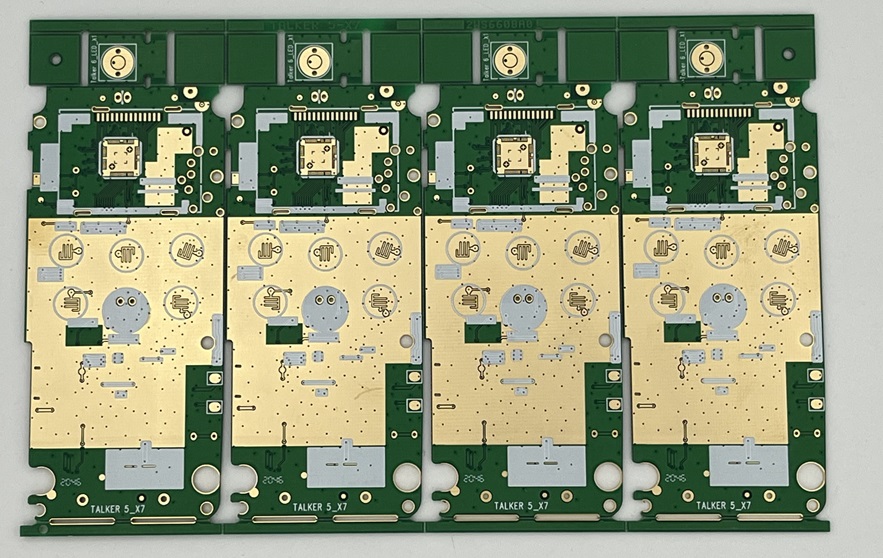
HF PCB
The Physics of Dielectric Loss and Df Stability
The total signal attenuation on a circuit board is the summation of conductor loss and dielectric loss. While conductor loss is governed by the physical dimensions of the trace, dielectric loss is a function of the substrate's Dissipation Factor Df. In an HF PCB, using materials with a Df as low as 0.0009 is essential because dielectric loss increases linearly with frequency. If a standard FR4 material is used at 28GHz, the energy absorbed by the resin would turn the board into a heater rather than a transmitter.
Furthermore, for phased-array antennas used in 5G beamforming, the Dielectric Constant (Dk)must remain ultra-stable across the entire operating temperature range. This property, known as the Temperature Coefficient of Dielectric Constant (TcDk), ensures that the phase of the signal remains consistent. Even a microscopic drift in Dk can cause the antenna beam to squint or lose its target, highlighting why advanced PTFE or ceramic-filled substrates are the foundation of modern high-frequency hardware.
Copper Morphology and the Skin Effect Challenge
At high frequencies, electrical current does not distribute evenly through the cross-section of a copper trace. Instead, it crowds toward the surface—a phenomenon known as the "Skin Effect." At 10GHz, the effective skin depth is only approximately 0.66\mum. Because the signal travels along the very edge of the conductor, the surface roughness of the copper foil on an HF PCB becomes a major source of loss.
If the copper surface is rough (as is common in standard foil to aid adhesion), the signal must travel along a much longer "tortuous" path, significantly increasing the resistive loss. To mitigate this, leading-edge fabricators utilize HVLP (Hyper-Very-Low-Profile) copper foils with a surface roughness (Rz) of less than 2\mum. By ensuring a smooth interface between the copper and the dielectric, engineers can reduce conductor loss by as much as 20% to 30% at millimeter-wave frequencies, ensuring that the signal retains its integrity from the transceiver to the antenna.
Hybrid Lamination and Thermomechanical Reliability
While high-frequency materials like PTFE offer unmatched electrical performance, they are often expensive and mechanically difficult to process. To balance cost and performance, many advanced designs utilize a "Hybrid Stack-up." In this configuration, the critical RF signals are routed on specialized HF PCB materials on the outer layers, while the internal layers for DC power and low-speed control utilize standard FR4.
However, hybrid lamination introduces significant manufacturing challenges. The Coefficient of Thermal Expansion (CTE) of PTFE is often much higher than that of FR4. During high-temperature lamination and subsequent reflow soldering, these mismatched materials expand at different rates, leading to interlayer delamination or via-hole cracking. Sophisticated manufacturing processes, such as plasma surface activation, are required to chemically modify the inert PTFE surface, allowing for a strong mechanical bond with the FR4 prepreg and ensuring the board survives the rigors of automotive or aerospace environments.
Precision Fabrication and Via Stub Resonances
In high-speed digital and RF circuits, "vias" or vertical interconnections can act as significant discontinuities. An unused portion of a via, known as a "stub," can behave as a resonant circuit that traps signal energy at specific frequencies, creating a "null" in the frequency response. For a professional HF PCB, back-drilling is a mandatory process. This involves using a secondary drilling cycle to remove the unused copper stub with a depth precision of +/-0.05mm.
Additionally, achieving an impedance tolerance of +/-5%(down from the industry standard +/-10%) is critical for minimizing Return Loss (S11). This requires the fabricator to use advanced etching compensation software and highly consistent dielectric thicknesses. By controlling the trapezoidal shape of the traces and the uniformity of the resin flow, manufacturers can ensure that reflections are kept to a minimum, allowing the system to operate at maximum efficiency.
Conclusion
As the electronics industry pushes toward 6G and high-resolution imaging radar, the technical demands on the circuit board will only intensify. The era of treating the PCB as a simple mounting plate is over; we have entered an era where the board is a precision-tuned microwave component. A high-performance HF PCB is the result of a perfect marriage between advanced material science and extreme manufacturing precision. By mastering the nuances of Df stability, copper morphology, and via resonance control, engineers can build the robust, low-loss systems required for the future of global connectivity. Ultimately, the quality of your high-frequency substrate is what will define the performance limits of your next-generation communication innovation.