A Trustworthy PCB and Electronic Manufacturing Enterprise! Contact Us


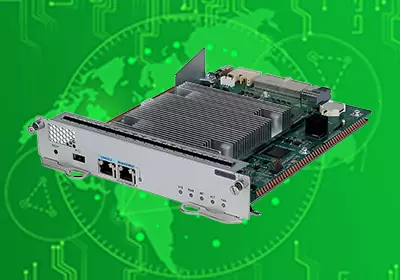
As December 2025 draws to a close, the electronics manufacturing industry is already looking ahead to 2026—a year poised for deeper integration of automation and intelligent systems. Box Build Assembly, often referred to as system-level assembly or box build, has become an essential bridge that transforms prototypes into market-ready products. Far more than simply “putting components in a box,” it involves carefully integrating all parts of an electronic device into a reliable, fully functional whole. This ultimate guide explores the core concepts, processes, benefits, and practical insights to help you fully understand this critical manufacturing stage.
At its core, Box Build Assembly is the final integration phase in electronics manufacturing. It starts with a completed Printed Circuit Board Assembly (PCBA) and combines it with cables, power supplies, enclosures, displays, mechanical supports, sensors, and other sub-components to create a complete, ready-to-use product.
This process goes well beyond basic PCB soldering. It focuses on system-level integration, ensuring the finished device not only powers on but performs reliably in real-world conditions. Box Build applies to everything from compact consumer gadgets to large-scale industrial control systems, highlighting the modular and efficient nature of modern electronics production.
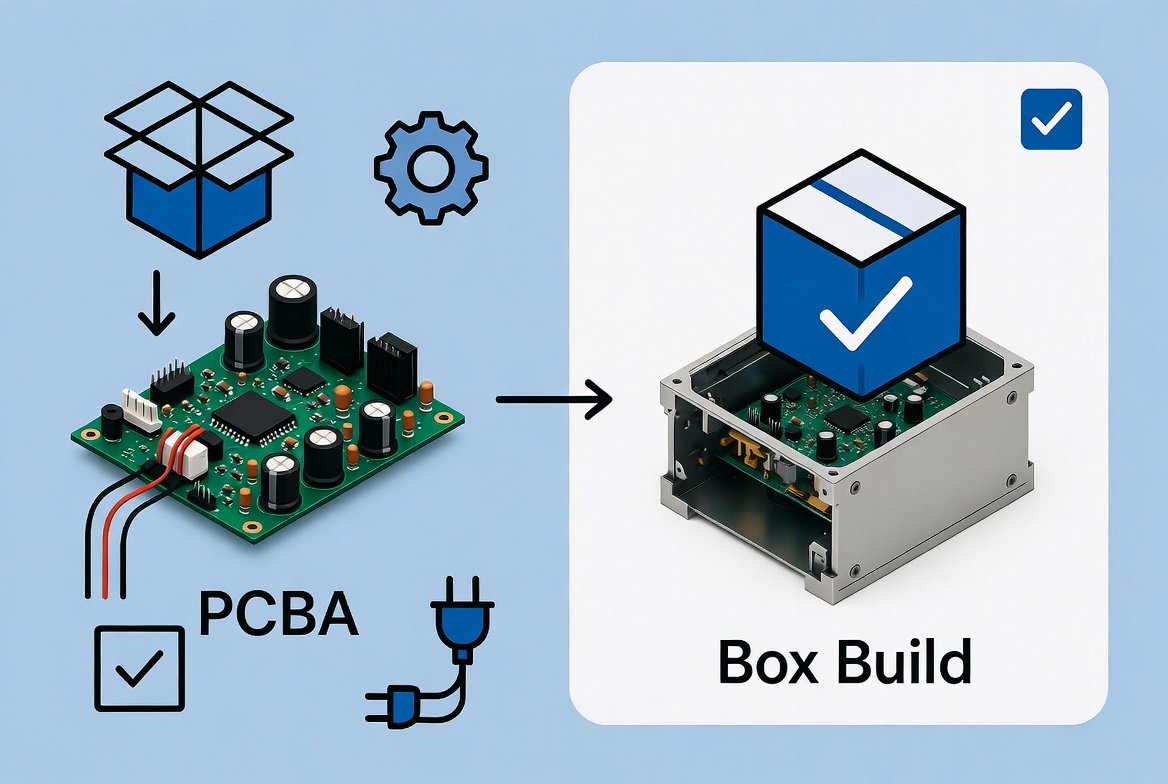
Many newcomers to electronics manufacturing confuse Box Build with PCBA (Printed Circuit Board Assembly), but they differ significantly in scope and depth. The table below highlights the main distinctions:
PCBA serves as the foundation, while Box Build emphasizes the “wholeness” of the product and its user-centered design.
| Aspect | PCBA (Printed Circuit Board Assembly) | Box Build Assembly |
|---|---|---|
| Primary Focus | Component placement and soldering on the board | Full system integration (mechanical, electrical, and functional) |
| Components Involved | Mainly electronic parts (resistors, capacitors, ICs) | PCBA + enclosure, cables, power supply, interfaces, mechanical parts |
| Complexity Level | Relatively standardized, precision-focused | Highly variable, requiring cross-disciplinary coordination |
| Final Output | Functional circuit board (intermediate product) | Complete, ready-to-ship device |
| Typical Applications | Motherboards, modular sub-assemblies | Medical devices, industrial controllers, smart home products |
A well-executed Box Build project follows a structured, modular workflow to ensure control and efficiency at every stage. The main steps generally include:
Planning and design validation – Reviewing customer-provided BOM, mechanical drawings, and functional specifications; simulating assembly compatibility.
Component sourcing and preparation – Acquiring PCBA, custom cables, injection-molded enclosures, and other parts while maintaining supply chain stability.
Mechanical structuring – Securing the circuit board, installing brackets, and adding cooling components to form the product framework.
Electrical interconnection – Professional wiring, connecting power sources, interfaces, and sensors while preventing interference or shorts.
Software configuration – Programming firmware, loading drivers, and performing initial system initialization.
Comprehensive testing – Conducting functional, environmental (temperature, vibration), and safety tests to verify reliable operation.
Packaging and logistics preparation – Adding user manuals, anti-static packaging, and certification labels.
The beauty of this process lies in its flexibility: it can scale from small-batch manual assembly to fully automated production lines depending on project needs.
In today’s highly competitive electronics market, adopting Box Build strategies delivers tangible benefits for companies:
Streamlined supply chain – Single-source integration reduces coordination across multiple vendors and minimizes delays.
Better cost control – Bulk purchasing and specialized labor often result in lower per-unit costs.
Faster time-to-market – Significantly shortened cycles from design to finished product help capture market opportunities.
Improved quality and reliability – System-level testing catches potential issues early, ensuring durable performance.
Strategic focus – Companies can concentrate on innovation and core design rather than intricate assembly details.
These advantages will become even more valuable in 2026 as products grow increasingly complex and multifunctional.
Q: Which industries primarily use Box Build Assembly?
A: It spans nearly all electronics-related sectors, including consumer devices (e.g., smart speakers), medical equipment, automotive electronics, industrial automation, telecommunications, and IoT products.
Q: How much more expensive is Box Build compared to PCBA alone?
A: Additional costs from mechanical parts and integration testing typically add 20%–50%, but overall supply chain optimization often leads to net savings.
Q: Is Box Build worthwhile for small-batch or prototype runs?
A: Yes—many service providers offer flexible low-volume, high-mix production that supports rapid design validation and iteration.
Q: What documentation is needed to start a Box Build project?
A: The essentials are a detailed BOM, 3D mechanical files, functional test specifications, and packaging requirements. The more complete the information, the fewer revisions later.
Q: What is a typical lead time for a Box Build project?
A: Prototypes usually take 4–8 weeks; production runs can shorten to a few weeks, depending on component availability and design maturity.
Q: Does Box Build include software and firmware support?
A: Yes—most projects cover firmware programming, system configuration, and custom software pre-installation for out-of-box functionality.
Q: How can quality risks be managed effectively during Box Build?
A: Early design-for-manufacturability reviews, partnering with experienced providers, and implementing staged milestone acceptance all help mitigate risks.
Q: Does Box Build support high levels of customization?
A: Absolutely—it can incorporate unique aesthetics, special interfaces, or additional mechanical features such as fans or displays.
Q: What strategic benefits come from outsourcing Box Build?
A: Beyond cost and speed, companies gain access to specialized equipment scale, improved product consistency, and stronger market competitiveness.
Q: How is environmental compliance handled in Box Build projects?
A: Reputable processes prioritize lead-free materials and adhere to international standards such as RoHS and REACH for sustainability.
Box Build Assembly is more than a manufacturing technique—it’s the vital link between innovation and real-world deployment. In 2026, it will empower even more companies to deliver efficient, reliable products to market. If you have questions about specific applications, feel free to ask!