A Trustworthy PCB and Electronic Manufacturing Enterprise! Contact Us


The shift toward Software-Defined Vehicles (SDV) and high-voltage electric drivetrains has fundamentally altered the technical requirements for printed circuit board fabrication. Modern vehicles are no longer just transportation tools; they are complex mobile data centers that operate under extreme thermomechanical stress. To meet these demands, the engineering of a car PCB board must transcend standard manufacturing protocols. Every layer, via, and trace must be optimized to withstand a lifespan of 15 years or more, facing constant vibration and thermal cycles ranging from -40°C to 150°C. In this high-stakes environment, material science and precision layering are the only ways to guarantee the "zero-defect" reliability required for mission-critical systems.
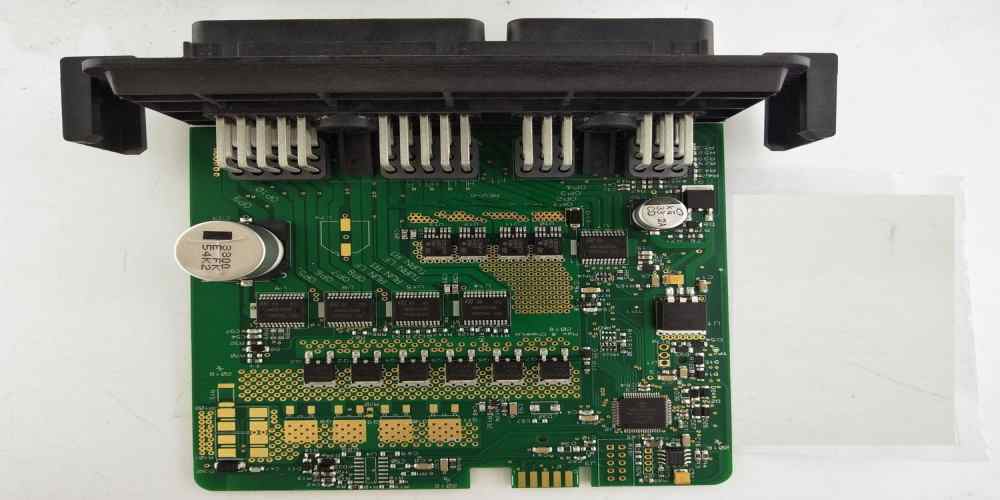
car pcb boards
Critical Material Selection and Thermal Dynamics
The foundation of a high-performance car PCB board lies in its base substrate properties. Standard FR4 is often insufficient for automotive power electronics due to its lower Glass Transition Temperature (Tg). Engineers typically specify High Tg (> 170 °C) and Low-CTE materials to ensure dimensional stability during lead-free reflow and field operation.
In power conversion modules, such as On-Board Chargers (OBC) or Inverters, thermal management is paramount. Here, heavy copper technology—utilizing copper weights of 3oz to 10oz—is integrated into the inner layers to handle high current density. For extreme heat dissipation, such as in LED lighting or power stages, Metal Core PCBs (MCPCB) or Ceramic substrates (Alumina or Aluminum Nitride) are employed to provide superior thermal conductivity (24-170W/mK), preventing localized thermal runaway and protecting sensitive semiconductors.
HDI and Signal Integrity in ADAS Systems
As vehicles integrate LiDAR, 4D imaging radar, and V2X communication, the car PCB board must support high-frequency signal transmission with minimal insertion loss. This necessitates the use of High-Density Interconnect (HDI) technology, utilizing staggered or stacked microvias to reduce parasitic capacitance and inductance.
Signal integrity in automotive radar systems often requires hybrid constructions, where high-speed PTFE-based materials (like Rogers or Isola MT77) are laminated onto standard FR4 cores. This approach balances cost with the dielectric stability needed for 7GHz or 79GHz radar applications. Furthermore, strict impedance control and shielding strategies are implemented within the stackup design to mitigate Electromagnetic Interference (EMI) within the cramped engine compartment.
Reliability Standards and Failure Prevention
A primary failure mode in automotive electronics is the growth of Conductive Anodic Filaments (CAF). This electrochemical migration can cause internal shorts between traces or vias under high humidity and voltage bias. To prevent this, a professional car PCB board must be manufactured using CAF-resistant materials and optimized glass-weaving patterns.
Compliance with the IATF 16949 quality system is the baseline, but automotive-specific standards like IPC-6012DA provide more rigorous criteria for wrap copper plating and via-fill integrity. These standards ensure that the interconnects can survive thousands of thermal shock cycles without fatigue cracking, a common issue in large-format boards used in modern infotainment and digital cockpits.
Advanced Testing for Harsh Environments
The "Zero Defect" philosophy in automotive manufacturing is supported by exhaustive end-of-line testing. Beyond Automated Optical Inspection (AOI), high-reliability boards undergo 4-wire Kelvin testing to detect microscopic resistance variations in the circuits.
Environmental Stress Screening (ESS), including High-Acceleration Life Testing (HALT), is used to identify latent defects in the solder mask or copper plating. For boards used in under-the-hood applications, salt spray and sulfur resistance tests are performed to ensure that the surface finish (such as ENIG or ENEPIG) provides adequate protection against corrosive gases and road salts.
Conclusion
As the automotive industry marches toward Level 4 and Level 5 autonomy, the structural and electrical integrity of the underlying hardware is the ultimate safety net. A precision-engineered car PCB board is more than just a component; it is a highly specialized platform designed to maintain signal purity and power stability under the most brutal conditions. By integrating advanced HDI techniques, high-Tg substrates, and rigorous thermal management, manufacturers can deliver the durability needed for the next generation of smart mobility. In an era where hardware reliability translates directly to human safety, the technical excellence of a car PCB board remains the most critical factor for automotive innovation.