A Trustworthy PCB and Electronic Manufacturing Enterprise! Contact Us



The foundation of every high-quality electronic assembly begins long before the first component is placed. In the Surface Mount Technology (SMT) process, the initial step of solder paste deposition is arguably the most critical. Research indicates that more than 60% of common assembly defects, such as solder bridging or insufficient solder, can be traced back to the printing stage. To combat these issues, manufacturers must rely on a high-performance pcb stencil printer to ensure that every pad on the board receives the exact volume of paste required. Achieving this level of consistency is the only way to minimize rework costs and maintain high throughput in a competitive market.
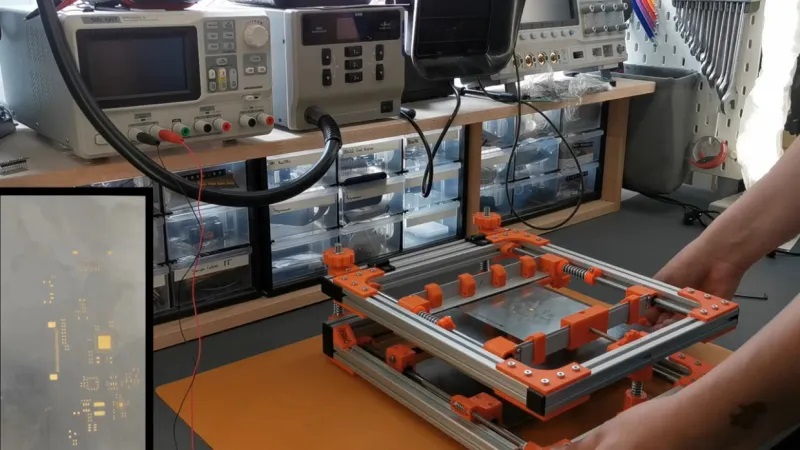
pcb stencil printer
Understanding the Role of Solder Paste Printing
A pcb stencil printer is a precision machine designed to transfer solder paste onto the copper pads of a printed circuit board through a laser-cut stainless steel stencil. The process sounds simple, but it requires extreme mechanical synchronization. The board is lifted against the stencil, and a squeegee blade moves across the surface, pushing the solder paste through the tiny apertures.
In modern manufacturing, these machines are categorized into manual, semi-automatic, and fully automatic systems. While manual printers are suitable for prototyping or low-volume batches, high-speed production lines require fully automatic machines that can handle thousands of boards with minimal human intervention.
Key Components That Drive Accuracy
What separates a standard machine from a world-class pcb stencil printer is the technology integrated into its core systems.
1. Vision Alignment Systems
Modern circuit boards feature microscopic pads for components like 01005 resistors or fine-pitch BGAs. Even a misalignment of a few microns can lead to catastrophic failures. Top-tier printers use dual-camera vision systems to scan "Fiducial Marks" on both the PCB and the stencil. The machine then automatically adjusts the table position to ensure perfect registration before the squeegee moves.
2. Controlled Squeegee Pressure
The squeegee is responsible for filling the apertures cleanly. If the pressure is too high, the paste is scooped out; if it is too low, the deposit will be uneven. Advanced printers utilize closed-loop pressure control to maintain a consistent downward force, regardless of the board's topography or the speed of the print stroke.
3. Integrated Stencil Cleaning
Solder paste buildup on the underside of a stencil is a major cause of smearing. High-performance printers feature automatic wet/dry cleaning cycles that wipe the stencil after a set number of prints, ensuring that the apertures remain clear and the board surfaces stay clean.
Choosing Between Manual and Automatic Systems
When selecting a pcb stencil printer, manufacturers must evaluate their specific production goals. Manual and semi-automatic printers offer the advantage of lower upfront costs and easier setup for diverse, small-batch projects. They are excellent for research labs or small repair shops.
However, for industrial-scale manufacturing, a fully automatic in-line printer is indispensable. These machines communicate directly with the rest of the SMT line via the SMEMA standard, allowing for seamless board handling and significantly higher yield rates. The investment in an automatic system often pays for itself through reduced labor costs and a dramatic decrease in defect-related waste.
Maintenance and Long-term Reliability
Like any precision instrument, a pcb stencil printer requires regular maintenance to perform at its peak. Operators should prioritize the calibration of the motion system and the inspection of the squeegee blades for wear and tear. Furthermore, using the correct grade of solder paste and maintaining a stable ambient temperature in the facility can prevent the paste from drying out or changing viscosity, which directly affects the quality of the print.
Conclusion
Precision in electronics manufacturing is an accumulation of small, controlled steps, and it all starts with the deposition of solder paste. A high-quality pcb stencil printer acts as the gatekeeper of quality, ensuring that the complexity of modern circuit designs is met with equal precision in production. By investing in a machine with advanced vision alignment and robust cleaning systems, manufacturers can build a more resilient production line that delivers consistent results every time. In a world where devices are becoming smaller and more complex, the reliability provided by a professional pcb stencil printer is the key to mastering the art of the perfect assembly.