A Trustworthy PCB and Electronic Manufacturing Enterprise! Contact Us



Modern electronics demand smaller, lighter, and more complex designs, necessitating a shift away from rigid boards. The flexible PCB substrate provides the solution, utilizing pliable materials to create durable circuits that bend and fold, enabling new possibilities for dynamic system integration and compact assembly in three dimensions.
Materials and Structure
The unique capabilities of the flexible PCB substrate are derived from its specialized base materials, which are chosen for their excellent dielectric properties and high flexibility.
1. Primary Materials
The most common base material is Polyimide (PI). PI offers exceptional thermal stability, making it ideal for high-temperature applications, and superior mechanical endurance for dynamic flexing. A less expensive alternative is Polyester (PET), though PET has lower thermal resistance and is generally restricted to applications that require static bending or single-use flexibility. The conductive traces, typically copper, are bonded to these flexible substrates.
2. Circuit Types
---Flex circuits are categorized by their layer count:
---Single-Sided Flex: One conductive layer, the simplest and most cost-effective.
---Double-Sided Flex: Two conductive layers, connected by plated through-holes (vias).
---Multi-Layer Flex: Three or more conductive layers, used for high-density signal routing.
The copper circuitry is protected by a flexible coverlay. Stiffeners (PI or FR-4) are added where needed to provide mechanical support for component mounting (SMT).
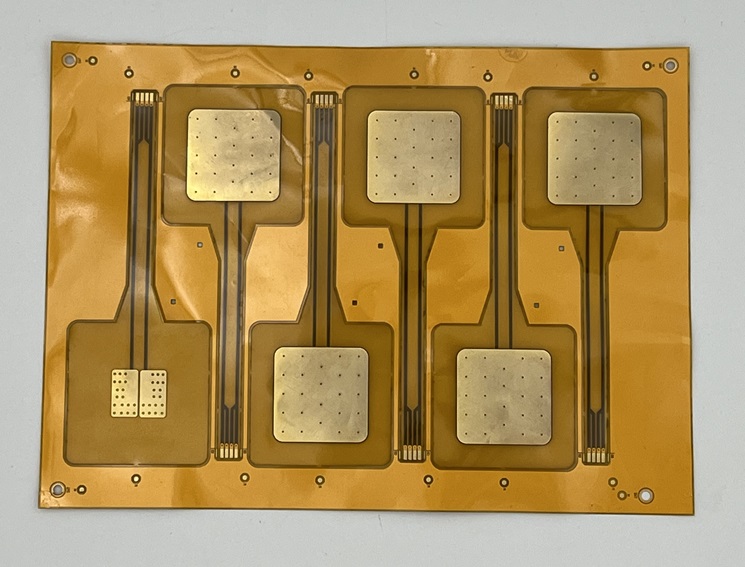
flexible pcb substrate
Key Advantages for Modern Devices
Adopting the flexible pcb substrate provides immediate, measurable gains in product performance and manufacturing efficiency compared to using conventional rigid boards and wire harnesses.
1. Space and Weight Reduction
Flex circuits inherently replace bulky, heavy wire harnesses and connectors with a single, lightweight ribbon. This elimination of mechanical connectors is critical for miniaturization, freeing up valuable internal space and dramatically reducing the overall weight of the device. In portable and wearable electronics, this weight reduction is a key competitive advantage.
2. Dynamic Application and Reliability
Unlike rigid boards, flex circuits are engineered for movement. They maintain electrical integrity under continuous flexing, making them indispensable for hinges, sliding mechanisms, and wearable devices. This dynamic reliability is far superior to that of fragile wires and solder joints, drastically reducing product failure rates in high-vibration or high-stress environments.
3. Thermal and Electrical Performance
Polyimide, the primary material used in the flexible PCB substrate, is a stable material that exhibits excellent resistance to high temperatures and superior electrical performance. Its thin nature aids in heat dissipation, pulling heat away from components and allowing the overall design to operate more reliably than equivalent rigid assemblies.
4. Simplified Assembly
Flex circuits are often designed to integrate multiple rigid PCBs, effectively creating a single, streamlined component that folds into the final enclosure. This one-piece design significantly reduces manual labor, assembly time, and the potential for human error associated with connecting multiple cables and complex wire routing.
Design Considerations for Flexible PCB Substrate
Designing with a flexible PCB substrate is fundamentally different from designing rigid boards and requires strict adherence to specific rules to ensure long-term reliability.
1. Bend Radius and Trace Routing
The primary rule is managing the minimum bend radius. If the bend is too tight, the copper traces can crack. Designers must use the largest possible bend radius. Furthermore, copper traces should always be routed perpendicular to the direction of the bend. Running traces parallel to the bend radius creates stress concentration points, leading to premature copper failure.
2. Component Placement and Stiffeners
Components should not be placed directly on the bending area. Stiffeners are mandatory under most components to provide a flat, stable platform for soldering and to spread mechanical stress. Component density must be managed carefully, as the thinner flex material has less capacity to sink heat away from highly concentrated areas. The manufacturing cost of a high-reliability flexible PCB substrate is initially higher than a rigid board, but the total system cost often balances out due to reduced assembly time and the elimination of expensive connectors.
Leading Applications
The ability of the flexible pcb substrate to conform to tight spaces and endure movement has made it indispensable across several cutting-edge industries:
---Wearables and Medical: Used in smartwatches, fitness trackers, cochlear implants, and disposable medical sensors, where the circuit must conform to the body or operate reliably within compact, encapsulated spaces.
----Automotive: Deployed extensively in steering column wiring, sophisticated dashboard displays, safety airbag systems, and complex sensor arrays where vibration tolerance is critical.
---Consumer Electronics: Essential in modern smartphones and tablets, connecting hinged displays, cameras, and batteries within incredibly small, dense enclosures.
Conclusion
The flexible pcb substrate is not just a niche product; it is a foundational technology that enables the next generation of portable, compact, and highly integrated electronic devices. Its unmatched ability to manage complex wiring in three dimensions while simultaneously reducing weight and enhancing reliability makes it crucial for meeting modern consumer and industrial demands. Embrace the design freedom offered by the flexible PCB substrate to push the boundaries of your product's form factor and functionality.