A Trustworthy PCB and Electronic Manufacturing Enterprise! Contact Us



In the modern electronics manufacturing landscape, the move toward miniaturization and high-density components has made the final stages of production more delicate than ever. One of the most critical steps in the assembly process is depaneling—separating individual circuit boards from a larger panel. Traditional methods often exert too much physical pressure on the board, risking damage to sensitive surface-mount components. To achieve the highest levels of precision and safety, investing in a high-performance pcb board router has become a necessity for manufacturers who prioritize quality and efficiency in their high-volume production lines.
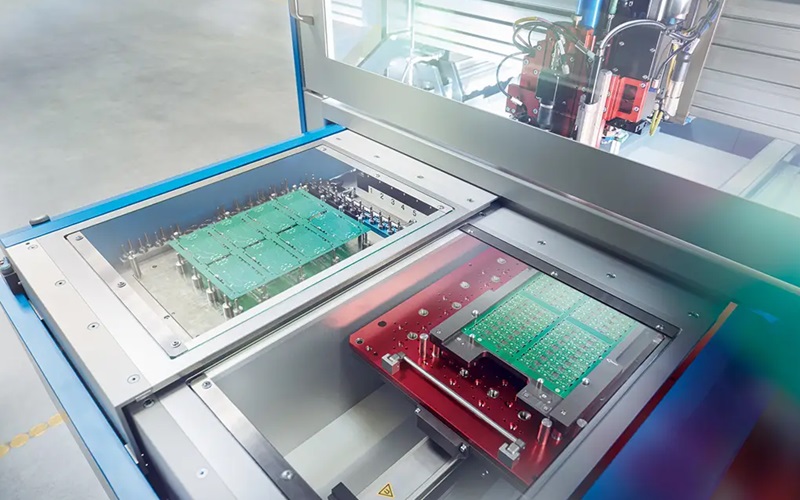
pcb board router
What Exactly is a PCB Board Router?
A pcb board router is a specialized computer-controlled machine that uses a high-speed rotating milling bit to cut through the bridge or "tabs" connecting individual PCBs in a panel. Unlike manual breaking or V-scoring, which relies on mechanical force to snap the board along a pre-cut line, a pcb board router "carves" the path following a pre-programmed digital design.
This additive-like precision allows for a non-linear cutting path. Whether your board has circular edges, complex cut-outs, or irregular geometries, a router can handle it with ease. Because the machine uses a spindle and a sharp bit, it effectively isolates the cutting forces, ensuring that the rest of the board remains stable and vibration-free throughout the process.
Key Advantages of High-Precision Routing
Why are world-class manufacturers switching to this technology? The benefits extend far beyond simple cutting.
1. Minimal Mechanical Stress
Standard depaneling methods like "pizza cutters" or stamping presses can cause the PCB to flex. Even a microscopic bend can crack a ceramic capacitor or loosen a BGA solder ball. A pcb board router minimizes this "stress coefficient" by using high-speed rotation instead of blunt force. This ensures that your high-value components remain functionally intact.
2. Superior Edge Quality
If your product is destined for a high-end consumer market, the aesthetic and physical finish of the board edges matters. Routing provides a smooth, burr-free finish. This eliminates the need for manual sanding or deburring, which saves time and prevents dust contamination on the clean assembly.
3. Unmatched Design Flexibility
As electronic designs become more organic and shaped to fit specific enclosures (like wearable tech), straight-line V-cuts are no longer sufficient. Routing allows engineers to design boards in virtually any shape, providing the creative freedom needed for modern industrial design.
Essential Features of Modern Routing Equipment
When selecting a pcb board router for your facility, several technical features define the quality of the output:
---CCD Vision Systems: High-end routers use cameras to "see" fiducial marks on the PCB. This allows the machine to automatically compensate for any slight misalignment during the loading process, ensuring the cut is always perfectly centered.
---Dust Extraction Systems: Milling FR4 creates fine fiberglass dust. An integrated vacuum system is essential to protect the health of operators and to keep the machine's mechanical parts clean and functional.
---High-Speed Spindles: The heart of the machine is the spindle. Professional routers typically operate at speeds between 40,000 and 60,000 RPM. This high velocity ensures a clean cut without tearing the copper or the laminate.
Comparing Depaneling Methods
While laser cutting is an emerging technology, it remains prohibitively expensive for many. V-scoring is fast but limited to straight lines and can only be used on boards where components are placed far from the edge. The pcb board router stands as the perfect middle ground, offering the flexibility and low-stress benefits of high-end tech at a much more accessible price point for scaling businesses. It is the workhorse of the automotive, medical, and aerospace electronics sectors.
Conclusion
As the electronics industry continues to push the boundaries of what is possible, the tools we use to build them must also evolve. Relying on outdated manual depaneling methods is a risk that few professional manufacturers can afford to take. By integrating an automated pcb board router into your workflow, you are not just buying a machine; you are investing in the long-term reliability of every device that leaves your factory.
Precision, flexibility, and the protection of sensitive components are the hallmarks of modern routing technology, ensuring that your production line remains competitive in an increasingly demanding global market. Whether you are scaling up for the first time or upgrading an existing line, a quality pcb board router is the key to unlocking true manufacturing excellence.