A Trustworthy PCB and Electronic Manufacturing Enterprise! Contact Us



When looking at a fully assembled electronics platform, the most distinctive feature is often its smooth, colorful outer coating, which is traditionally a deep green but now spans a variety of modern corporate colors. This coating is not decorative; it is a vital polymer layer applied over the raw copper traces during fabrication. For electronic hardware designers, producing a high-yielding solder mask PCB is the baseline standard for ensuring that components can be soldered safely without creating manufacturing defects. Without this protective barrier, bare copper traces would remain entirely exposed to the elements, making them vulnerable to environmental corrosion, accidental solder shorts during factory assembly, and electrical breakdown under high voltage conditions.
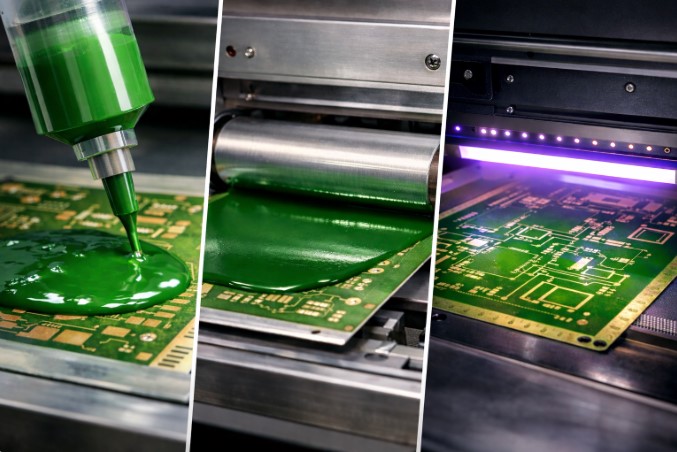
solder mask pcb
The Multi-Functional Roles of the Protective Layer
The primary job of the solder resist is to prevent a phenomenon known as solder bridging. During the automated wave soldering or reflow soldering processes, liquid solder naturally wants to adhere to any hot metallic surface it encounters. If the spaces between fine-pitch IC leads are not insulated, molten solder can easily pool between adjacent traces, forming an accidental short circuit.
Additionally, the mask serves as a long-term defensive shield against environmental factors. Raw copper oxidizes quickly when exposed to atmospheric humidity and oxygen, which degrades its electrical conductivity over time. By sealing the circuit traces beneath a permanent layer of polymer resin, a solder mask PCB effectively blocks moisture, salt spray, and airborne dust particles, thereby eliminating the risk of electrochemical migration and dendritic growth in high-reliability applications like medical or automotive control units.
Material Types and Application Processes
In contemporary manufacturing lines, Liquid Photoimageable (LPI) ink is the global standard for coating a premium solder mask PCB. The LPI process functions similarly to standard photographic film exposure. The entire panel is blanketed with liquid epoxy-acrylic resin via curtain coating or screen printing. After a brief pre-bake, the board is exposed to ultraviolet (UV) light through a precision photomask that mirrors the circuit design.
The areas exposed to UV light cure and harden completely, while the unexposed areas covering the component pads remain soft and are easily washed away in a developing solution. While classic green remains popular because its visual contrast minimizes operator eye strain during manual inspections, designers working on high-power LED systems often specify specialized gloss white inks to optimize light reflection, whereas high-end consumer gear frequently utilizes matte black for a premium aesthetic look.
Engineering Design Rules and Clearance Control
For layout engineers, managing the solder mask opening or clearance is a critical CAM verification step. The opening must be slightly larger than the actual copper pad to account for mechanical registration tolerances at the factory. If the factory alignment drifts slightly and the opening shifts, the solder mask could accidentally encroach onto the surface of the component pad, causing an incomplete solder joint or a complete open circuit.
A standard industry design rule is to maintain a minimum clearance of +0.05mm (2 mils) around each pad. The thin strip of polymer left between two adjacent openings is called the solder mask dam. This dam is the physical wall that keeps solder confined to its designated pad. If the pitch between pins on a microcontroller is too narrow, the dam may become too thin to adhere properly to the substrate and could peel off during manufacturing, emphasizing why strict compliance with advanced aspect-ratio rules is essential for high-yield production runs.
Thermal and Signal Integrity Considerations
While the mask is excellent for insulation, it can introduce unexpected behavior in ultra-high-frequency designs. When working with a high-speed solder mask PCB, the polymer ink acts as a lossy dielectric material that sits directly on top of the copper transmission lines. At transmission frequencies exceeding 10 GHz, the polymer ink acts as a lossy dielectric material that sits directly on top of the copper transmission lines. It introduces a secondary dissipation factor (Df) that can increase total insertion loss and slightly alter the characteristic impedance of microstrip traces.
To overcome this signal integrity challenge, RF engineers often implement a technique called a mask cutout, where the solder resist is completely removed from the top of critical high-speed traces. Furthermore, this same cutout technique is utilized in high-power electronics. By exposing the copper traces around heavy power rails, engineers can apply extra solder or bolt on external busbars to handle immense currents, using the bare copper to maximize thermal radiation directly into the air.
Conclusion
Precision in the chemical application room is what separates a long-lasting, industrial-grade device from a cheap consumer toy prone to mysterious field failures. As component spacing continues to shrink toward sub-millimeter pitches, the tolerances required to manage the insulation barriers will only grow tighter. A well-engineered solder mask PCB is a critical asset that directly improves the overall durability of your product while significantly lowering your factory rework costs. By mastering the nuances of LPI clearance, solder mask dam width limitations, and thermal cutout strategies, developers can transition safely from an initial prototype into a high-yielding, mass-manufactured product. Ultimately, allocating the engineering time to fine-tune your mask parameters is the most effective step toward delivering a robust electronic assembly that ensures long-term customer satisfaction.